Monday, 14 April 2014

Double Trouble - Caprice Nisei, NAPD Contract and... Morning Star?

Double Time is here, and with it comes yet another shot in the arm for Corporation decks with powerful new cards.  No longer can Corp cry foul at the power of Runner decks because the pendulum of power is swinging inexorably towards the men with suits and spreadsheets.

There are many powerful cards in Double Time but there are two in particular that I want to talk about because they're probably the most influential and game-changing in this data pack, and they work well in tandem: Caprice Nisei and NAPD Contract.


These cards combine to threaten widespread changes to the Netrunner metagame which has remained dominated by Fast Advance builds - Biotic Labor and SanSan City Grid - or the impending threat of flatline from aggressive Weyland builds - Scorched Earth.  Those three cards are all high-influence and high-impact cards that define the Corp strategies to a large extent, one representing Weyland, one NBN and one Haas-Bioroid.  In Caprice Nisei the Jinteki shareholders finally have a high influence powerhouse to rival the others, although she plays very differently and requires different tools to support her.

You can explain what Caprice Nisei does by going back to my blog about the different types of Ice.  Caprice sits behind your Ice defenses and adds an extra unbreakable End The Run effect, although one that you can't always rely on.  If you wanted to try and fit Caprice into one of the pigeon holes I used for classifying Ice (even though she's not Ice) then she would probably count as Analogue ETR in that she's designed to end runs, is certainly not Binary as she's unaffected by Icebreakers, and that quite how much she costs to get by her is entirely analogue - anywhere from 0 credits to infinity clicks and credits!  How long Caprice delays the runner for is largely random - it could be that they get in first time, or it could be at the twelfth attempt - but If the runner runs Caprice enough times they will eventually slip by your psychic detective and trash her.  For this reason Caprice works MUCH better with analogue Ice than with Binary Ice - if the Runner can plow through your Ice cheaply and quickly then Caprice can't hold them off for long, but if your Ice is big and expensive enough to break then the Runner will have to pay dearly for each Caprice lottery ticket they buy and may well decide it's simply not worth trying to get in at all.
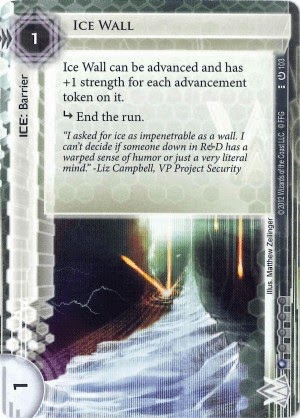

The Ice that support Caprice Nisei decks are therefore almost the antithesis of the Ice that support Biotic Labor/SanSan decks.  Cheap Binary ETR Ice like Ice Wall and Wraparound are far less useful than Analog Ice like Eli v1.0, Heimdall v1.0 or the new Hive in Weyland.  Similarly the default Enigma and the new Quandary are less attractive than Viktor v2.0, and in Sentries Rototurrets and Neural Katana are weaker cousins to Ichi v1.0 or Tsurigi with their many subroutines.  You want big strength Ice and lots of subroutines so that the Runner has to bleed credits to get past even after their rig is established, and Caprice will be waiting to play Rock-Paper-Scissors at the end of their run... "you paid 7 credits and didn't access any cards.  Unlucky.  Want to try again?"


Rezzing a Heimdall instead of Ice Wall takes money, and money takes time.  These new decks are slower and greedier so the Ice defenses are typically supported by heavy duty economy Assets that will deliver huge cash benefits if left alone by the runner (with taxing Ice in front of them to deter the runner from trashing).  This is a second seismic change, after the impact on Ice choices, which is that these decks largely abandon the Operation-based economy (Beanstalk Royalties, Sweeps Week, Green Level Clearance) that we've seen from Corps in Spin Cycle and often return to the more old school cards like Melange Mining Corp, Adonis Campaign, Eve Campaign, Sundew in Jinteki and even PAD Campaign.

So far we've talked about how Caprice Nisei has created an opportunity for new deckbuilding strategies but where does NAPD Contract fit into all this?  It turns out that NAPD Contract fits perfectly into a deck that has a lot of taxing Ice but little Binary ETR.  Fighting through a bank of Ice and Caprice Nisei (and cards like Ash or Red Herrings as well) only to find yourself unable to pay 4 to steal NAPD Contract when you access it is an enormous kick in the teeth to the runner.  NAPD Contract joins Nisei MkII as the best possible Agendas for a taxation Ice strategy, not just safe in your remotes but also in R&D and HQ.  NAPD Contract also has fringe benefits with Caprice Nisei - if the Runner is on 5 credits when they break through your Ice you know you are safe to bid 2 credits with Caprice, even if the Runner matches your bid and access NAPD Contract they'll be a credit short of stealing it!  Finally, the downside on NAPD Contract is that you can't run Bad Publicity with it easily, but in a taxation/Caprice strategy you have already avoided Bad Publicity like the plague anyway (if you're smart)!

Let's pause now to give you a look at what these new decks might look like, one in Haas-Bioroid and one in Jinteki...

HB Redcoats Caprice NAPD

Haas-Bioroid: Engineering the Future (Core Set)

Agenda (9)
3x Accelerated Beta Test (Core Set)
3x NAPD Contract (Double Time)
2x Priority Requisition (Core Set)
1x Project Vitruvius (Cyber Exodus)

Asset (10)
3x Adonis Campaign (Core Set)
2x Aggressive Secretary (Core Set)
3x Eve Campaign (Humanity's Shadow)
1x Jackson Howard (Opening Moves) •
2x PAD Campaign (Core Set)

Upgrade (4)
2x Ash 2X3ZB9CY
2x Caprice Nisei (Double Time) ••••• •••

Operation (7)
3x Hedge Fund (Core Set)
2x Interns (Mala Tempora)
2x Restructure (Second Thoughts)

Barrier (8)
3x Eli 1.0 (Future Proof)
2x Heimdall 1.0 (Core Set)
2x Heimdall 2.0 (Creation and Control)
1x Wotan (Second Thoughts)

Code Gate (6)
2x Quandary (Double Time)
3x Tollbooth (Core Set) ••••• •
1x Viktor 2.0 (Creation and Control)

Sentry (5)
2x Ichi 1.0 (Core Set)
1x Ichi 2.0 (Creation and Control)
2x Rototurret (Core Set)

This is a variant of the upcoming 'Red Coats' Haas-Bioroid deck that has been picking up Store Championship wins at the end of the season, and you can see here many of the hallmarks of what I was talking about above - multiple economy Agendas, big Taxing Ice and upgrades like Caprice and Ash to protect their Agendas.


Quicksandteki

Jinteki: Replicating Perfection

Agenda (10)
1x Braintrust
3x Fetal AI
3x NAPD Contract
3x Nisei MK II

Asset (16)
2x Encryption Protocol ••
2x Jackson Howard ••
3x PAD Campaign
1x Ronin
3x Shock!
2x Snare!
3x Sundew

Upgrade (6)
3x Caprice Nisei
3x Hokusai Grid

Operation (3)
3x Celebrity Gift

Barrier (5)
3x Eli 1.0 •••
2x Wall of Thorns

Code Gate (4)
2x Chum
1x RSVP ••
1x Tollbooth ••

Sentry (5)
2x Ichi 1.0 ••••
3x Tsurugi

This Jinteki deck relies on the power of its identity, forcing runners to hit Centrals before coming to look at remote servers.  That alone wastes clicks and plays into the hands of Caprice Nisei, but on top of that ALL of the ice is intended to be expensive to break with the classic Icebreaker rig - there isn't a single Binary piece of Ice in the deck!  It's painfully expensive for the runner to get anything out of this deck, which then compounds the issue with long term drip feed economy from Sundew and PAD Campaign, and Encryption Protocols to make trashing even more painful.  When Honor & Profit arrives this deck will benefit from the addition of cards like Inazuma, Komainu and The Future Perfect to further tax and frustrate the runner.


These two decks are very different in cards but very similar in ultimate strategy - overload the runner's economy.  An initial layer of Ice is there purely to slow the early game bleeding of Agenda points and protect economy assets.  Those assets provide the Corp with the cash to install a second layer of defenses - Ice, Caprice, or Ash - and slow the game even further.  At this point the runner's short term economic gains from cards like Sure Gamble/Daily Casts/Dirty Laundry are probably a distant memory, and even top notch Desperado/Datasucker rigs can't make accesses cheaply enough to make runs economically.  Sucks for the runner, but the Corp's assets are still pulling in more money and laying down yet more Ice and then the runner is shut out.

So you fight the economy assets, right?  But that's expensive too.  If the runner trashes Eve Campaign and PAD Campaigns the Corp doesn't benefit but the runner is bankrupting themselves in the process which just helps the Corp anyway.  And all the while the Runner is having to worry about having money aside for Ash, Caprice or NAPD Contract.  Nothing comes cheap and most runners simply don't have the funds to pay for everything they need.


So, as the runner, how do you fight this?  I think Caprice Nisei triggers changes in Corp decks that have some surprising knock-on effects in how Runner cards are valued.  First of all, here are some Runner cards that we are used to seeing a lot of, but which I believe get worse as Caprice Nisei bleeds into the metagame:


One of the best Runner cards today, Corroder, is actually one of the biggest problems with facing Caprice Nisei taxing decks.  Corroder is perfect to face Ice Wall, Wraparound, Himitsu-Bako or Wall of Static but becomes incredibly expensive against cards like Heimdall v.1 (7 credits), Hive (6 credits at full strength) or Wall  of Thorns (5 credits).  As soon as you pay that sort of money and run into a Caprice Nisei on the far side the Corroder seems a lot less like value for money.  Datasucker and Desperado are two cards that suffer from the Corp giving you no cheap runs, they're still great cards (Datasucker in particular can really help with big Ice) but can no longer be relied upon to power you through time and again, paying you back more than you invested in making the run, because the taxing Ice is so expensive to hit.  If you're running the classic Mimic/Yog.0/Datasucker rig it's entirely possible that the Corp will be able to cover all their Centrals with sizeable taxing Ice you need Datasucker counters to break and then purge Viruses, effectively locking you out for good.  

Dirty Laundry is similar, although the effect is more pronounced - a taxing piece of Ice in place can quickly make Dirty Laundry a losing proposition and although you get valuable cash back that happens AFTER the run, meaning you're 2 credits down when facing Caprice or Ash, or trying to steal an NAPD Contract.  Inside Job is similar again - against a big taxing piece of Ice an Inside Job is going to be a money saver but the difference is that you can no longer rely on Inside Job as a cheap way to snipe Agendas in the early game - there are more cards that will be installed that look like Agendas, and Caprice Nisei loves randomly cancelling any Event runs and wasting your investment.

Finally, R&D Interface is less about either Caprice Nisei or NAPD Contract and more about the rise of Jinteki decks in general.  When Jinteki is around in the metagame you will have to be VERY careful about playing multi-access cards that could mean you access multiple Ambush cards at once and I think there is a swing between R&D Interface and Indexing on the cards.  Indexing allows runners to dig deep while avoiding accessing cards they don't want, although the downside to Indexing is having to plow through taxing R&D twice in order to steal any Agendas you see.

So much for cards that I think have got worse, here are some Runner cards that I think get better in a Caprice Nisei metagame:



*** Edit - in the original entry of this blog I had misremembered Morning Star as a STR 7 base breaker, and thus got a little overexcited about it's meta-busting potential.  I've amended the following paragraph to allow for that ***

Morning Star is a card that can have a big impact on the Caprice Nisei/taxing matchups because it changes the nature of what their Ice actually does.  If we go back to my article about Ice types for a second time I mentioned in my analysis that the the classification of each piece of Ice changes depending on the type of Icebreakers you play against and what Morning Star does is transform pretty much all the Analog Barriers in the game into Binary ice that you can crush with a single credit.  Eli, Bastion, Rainbow, Wall of Thorns and Hive - Corroder hates playing against all these cards but Morning Star doesn't care.  Throw in some help like a Datasucker or Personal Touch/Dinosaurus and the Morning Star smashes through the Heimdalls of this world too - only an advanced Hadrian's Wall or well-positioned Curtain Wall truly can stop the Mjolnir of Icebreakers!

Switching Corroder for Morning Star critically damages a key part of the taxing Corp's gameplan.  If you can get through the Ice cheaply then you can afford to run multiple times against Caprice.  If you can get through the Ice cheaply then you can afford to trash the economy assets behind them.  If you can get through the Ice cheaply then you can score NAPD Contract when you access it.

Joining Morning Star in hogging precious MU is Magnum Opus, which is the runner's best option for simply overpowering the Corp's taxation Ice by drowning you in credits.  Where other economy cards like Sure Gamble, Daily Casts and even Account Siphon are one-shot affairs that will soon see their credits hurled against a big piece of Ice in a single access, the Magnum Opus keeps paying out for the entire game.  Similarly Kati Jones increases in value for the same reason - she's the economy Resource that is reusable and forms a key part in ensuring that the Runner economy can stay strong enough for long enough to match the Corp's Eve Campaigns and PAD Campaigns in a longer game.

Indexing and Parasite are two cards that both gain and lose value at the same time.  I already discussed why I think Indexing becomes an attractive option to R&D Interface when Jinteki brings more Snare! and Shock! into the metagame, but that it requires multiple runs through taxing Ice to secure those Agendas, and in Parasite there's another double-edged sword.  If Corps are running Eli instead of Wall of Ice and Viktor 2.0 instead of Quandary then Parasite takes a big hit because Ice is that much bigger, but on the other hand the game is going to last longer and being able to remove an expensive piece of Ice with Parasite is probably the most efficient long term solution to many of the taxing pieces of Ice you'll meet.  What swings Parasite towards gaining more than it loses, in my eyes, is twofold - if your deck is focussed on breaking Heimdall and Tollbooth then you will benefit from a cheap answer to Wall of Ice and Quandary in the form of Parasite - and if Jinteki is coming to the party then cards like Tsurigi and Komainu are likely to be among their taxing Sentries of choice, and both are juicy Parasite targets due to their Strength/Subroutines imbalance.

The final card I want to highlight is Whizzard, and the Master Gamer has been waiting a long time for his moment in the sun.  For the longest time the go-to Anarch Identity was Noise, with many games won by simply flipping a dozen cards into the Corp's Archives over the course of the game then cashing in multiple agendas at once.  Jackson Howard spelled the end of that strategy when he was printed because the Corp could now shuffle the Agendas back into R&D.  It seemed as though Whizzard was primed to take over but in fact Jackson Howard also nerfed the gamer as well as the punk because by adding more draw power to Corp decks Jackson Howard played a key role in switching Corps away from asset-based economies into being able to reliably keep up a supply of Operation economy cards - just as Whizzard was rubbing his hands at trashing Adonis Campaign and PAD Campaign those cards got taken out of Corp decks.  Then partway through Spin Cycle Reina Roja came along, everyone got excited about playing with Caissa and Whizzard went for a lie down and a sulk.  But now might be his time.  If Caprice Nisei is bringing longer games back, and with it asset economies, then Whizzard could be the perfect man for the job of fighting the Corp's economy and keeping them poor.


I'm going to finish by showing you a sample Runner deck that I believe is well-equipped to fight Caprice Nisei.  I'm going to hold my hand up and admit that this deck is almost entirely untested, I simply pulled 45 cards out of my binder and threw them into combat, but the results were pretty much exactly as expected - Morning Star and Whizzard combined to shred the game plan of both the Replicating Perfection and Weyland Big Ice decks I played against.  The Replicating Perfection deck had repeatedly left my successful Andromeda deck gasping for air but with this Whizzard deck the matchup was for more comfortable.  

While I'm sure a lot is wrong with this deck as it is, I'm happy that it's heading in a direction that has real benefits to bring out as the deck is refined...

Magic Hammer

Whizzard - Master Gamer

Event (11)
2x Déjà Vu
3x Quality Time •••
3x Special Order ••••• •
3x Sure Gamble

Hardware (7)
2x Cyberfeeder
3x Grimoire
2x Spinal Modem

Resource (9)
2x Armitage Codebusting
3x Daily Casts
2x Kati Jones
2x Liberated Account

Icebreaker (7)
1x Corroder
2x Mimic
2x Morning Star
2x Yog.0

Program (11)
3x Datasucker
2x Imp
1x Medium
3x Parasite
2x Self-modifying Code ••••• •

All the Influence spent goes on improving consistency, which has long been the bane of Anarch decks I've seen, while the rest of the deck is quite familiar, I guess.  There is lots of economic resources and plenty of MU available for all the tricky viruses to sit alongside Morning Star.  Playing two banks of Consoles is something that looks pretty ropey but you HAVE to get that +2MU down if you want to support Morningstar + Datasucker + Parasite in your rig.  Having five cards to find (plus three Quality Time to help you power through and find them) means you should see a Console early in >75% of your games and while in some matchups the downside of Spinal Modem will prove horrible, in other games those 2 recurring credits will be a perfect compliment to your fighting a taxation Corp.

The real trick is combining a deck that can cope with Caprice Nisei with a deck that can still move quickly enough to threaten Fast Advance.  Anyway, as I said this is 100% a very rough draft, but indicative of what type of decks I think may arise to tackle Caprice Nisei, if she comes to be a large part of the metagame.  It could just as easily be built in Shaper, I guess, using Test Run/Scavenge to get Morning Star out (and then you've got that tempting Paintbrush/Morning Star combo to look at) but I wanted to run the Parasite package alongside Morning Star, which sent me down the road to Anarch and Whizzards ability.


The Bottom Line


All told, I think NAPD Contract and Caprice Nisei are going to make very real and sizeable changes to the Netrunner metagame.  A lot of people are exploring how to maximise them in Corp decks but I'm just as interested in how the Runners will respond, and I can see some fascinating possibilities opening up that may challenge the accepted wisdom about a lot of cards.  Until now competitive Runners have really only have to worry about variations on a single theme - quick Corp decks looking to get to 7 Agenda Points as quickly as possible by any means necessary.  If a genuinely different Corp deck style comes to the fore it is likely to lead to radical changes on the Runner side, and that could freshen things up considerably by challenging some well-established preconceptions.

Fingers crossed!


Thursday, 10 April 2014

"Half of North America just lost their Facebook"

The Satellite Uplink will be shutting down.  Like George Clooney in Gravity, I'm detaching the cable and drifting off to admire the view.


I've enjoyed my time playing Android: Netrunner and greatly enjoyed writing this blog, but I think my time with the game is ending.

I didn't blog much throughout the Store Championships because I was playing and thinking about the game so intently.  Unfortunately that seems to have been my undoing - I played in 5 Store Championships over 6 weeks and somewhere along the line I simply overdosed on Netrunner and stopped enjoying it.

My Store Championship journey was a very positive one - each event was 20+ players with 5 rounds of Swiss and I made Top 4 in all but the last one, which is a record I'm proud of.  But for all my winning ways by the last two Store Championships I was making a lot of mistakes and losing games that I shouldn't have lost.  Analysing why those mistakes had started to creep into my game told me something important: I'd stopped caring.  

I was no longer enjoying playing Netrunner, I was no longer interested in the games, and as a result I was sleepwalking into bad situations and bad decisions.  My knee jerk reaction was to quit the game and sell my cards but enough people gave me sage advice to take a break and recharge that I decided to do so.  However several weeks down the line I find that I still have no enthusiasm for the game.  There are no decks I want to build, no cards I want to experiment with, no identities I want to explore, and no matchups I want to play.

I think that means it's time to leave.

This may well not be my final blog, though.  One of the ironies is that as much as I'm bored of Netrunner I still enjoy writing about the game and I remain very proud of this blog, so even though I don't enjoy playing any more there may be a few things I find time to write about before I finally turn the lights off.

If so I hope you'll continue to do me the honor of reading my words.

-
Dave

Wednesday, 12 March 2014

The Chronos Protocol - Who Will You Vote For?

Store Championship Season is only halfway done and already attention is beginning to slip onto what is coming beyond that, which in Europe is the upcoming Chronos Protocol Tour.  At the end of last year the US players got their chance to vote on which runner Identity would be added to the game (correctly choosing to flip "The Collective" the finger) and now European players will get the chance to decide between two Corp identities who are vying for the Chronos Protocol. 


When the decision between The Collective and Laramy Fisk was being made there was a huge number of games being played on OCTGN that helped guide the decision that The Collective was simply too powerful, but so far there are less than 100 games being played with the two Chronos Protocol identities combined so this is still a decision that is up in the air. 

Whether you're wondering where to cast your vote, or looking on anxiously from across the Atlantic Ocean and hoping your pick will be the one given the nod, taking a look at the two Corp IDs that may shape the game in future is a worthwhile venture...


Haas-Bioroid

Haas-Bioroid received a bunch of new Identities in Creation and Control but none of those identities really helped with one of the Corp's key themes, which is Brain damage.  Brain damage isn't something we've really seen in competitive environments too often, but it's something that is very popular with non-competitive players and I know a lot of players would like an Identity that played towards that theme.

Permanently removing all copies of a card from the runner's deck is also a new and very attractive effect.  In Magic: The Gathering effects like this have a long-running place in the game, from the original Lobotomy through the staple spoiler Cranial Extraction.  Surgically removing a card from the opponent's deck has proven a useful control on abusive combo decks, and it's an effect we've not seen in Netrunner yet.

There are two key words in that last sentence that I want to address as I explain why Haas-Bioroid will not be gaining my vote.  

The first of those words is 'surgical'.  Randomly choosing a card from your opponent's hand is the opposite of a surgical strike - I wouldn't go into hospital knowing that the surgeon is going to use ippy-dippy to decide what vital organ he's going to remove!  Attaching such a powerful effect to a mechanic that is ultimately random is something that I am very wary of introducing to the game.  The difference between removing all copies of Daily Casts or removing all copies of Corroder is a huge one and it's one that neither player has much control over.  Hit Daily Casts and the runner frowns but carries on, hit Corroder and it could be effectively game over as early as the runner's first click.  Should that sort of swinginess really be attached to a random effect?

The second of those words is 'combo', and I would argue that to some extent every Runner deck is a combo deck, with the various parts of the rig representing the combo the runner is trying to assemble.  In Magic: The Gathering cards like Cranial Extraction dissuade many players from playing combo decks but in Netrunner the runner doesn't have much choice about the matter.  Yes, the runner can build a deck with backup breakers so they don't fall over if a particular Icebreaker is lost, and to some extent it would be desirable if Chronos Protocol became a reason why more Fracters than Corroder were played, but there are other cards where there aren't so many options available.  Plascrete Carapace comes to mind as a great example - do you want to drop down to a maximum hand size of 4 AND lose all your Plascrete Carapaces at the same time, just because of a unlucky card picked from your hand?

Ultimately, I feel the Haas-Bioroid version of Chronos Protocol introduces an undesirable element of luck into the game - games could easily by lost by receiving an early Brain damage that strips a vital component from your deck.  This impacts non-competitive decks attempting to do something cool as much as it does competitive decks (oops, I took Blackguard... good luck!).  It makes Brain damage so potentially unpleasant that runners will avoid running, making the game less interactive, and I think it would become a constraint on future cards being printed that deal Brain damage.


Jinteki

At the moment Jinteki only has two Identities but that is about to change, with three more coming in Honor & Profit in just a month or two.  The new Identities all support new play styles but the core Jinteki theme of sizzling the runner with Net damage will remain the domain of Personal Evolution.  The Chronos Protocol would give Jinteki players a new Identity to play with their core cards, and a whole new way of looking at Net damage.

One of my key reasons for disliking the Haas-Bioroid version of Chronos Protocol is that it over-emphasises a random effect, whereas for Jinteki my main reason for liking this ID is that it REMOVES a random effect and introduces a skill decision in its place.  This is a good thing, particularly for good players who are most likely to gain value from the information and decision they are being presented with.  Currently Net damage in Jinteki really only serves one purpose - kill the runner, or threaten to do so - but under the Chronos Protocol the nature of net damage changes completely and becomes pro-active disruption and control of the Runner's capabilities, with the Corp able to plan around the cards the runner is holding, and also work on a strategy to discard certain types of card (remove Icebreakers, remove economy).  

How will Chronos Protocol change how Jinteki is played?  Well, you only really need to think about one card to see how much it changes things - Neural EMP.  Neural EMP is commonly played in Jinteki decks but in Personal Evolution this card is virtually always held in hand until multiple copies are ready to flatline the runner after they hit an unfortunate Snare!.  In Chronos Protocol Neural EMP becomes a card that you play at the earliest opportunity to snipe the best card or Icebreaker from the runner's hand.  Not just EMP, any card that does only a single Net damage hugely gains in value - Swordsman, Shock! and even Data Mine become serious problems that the runner can't ignore.  Cards that deal multiple net damage, like Neural Katana, actually gain less from Chronos Protocol than Swordsman would - discarding 3 cards at random gives you a higher chance of taking the best cards anyway - and I really like that Chronos Protocol would flip the value weighting behind what net damage cards are good and which are bad.

Another point in the Jinteki favor, to my eyes, is the respective position of the Corps in competitive play.  Jinteki is a distant 4th in any rankings of Corp performance, while Haas-Bioroid already has an excellent ID in Engineering the Future and one of the most threatening new strategies in Cerebral Imaging.  By comparison Jinteki is in a very weak position (pre-Honor & Profit) and I'm not yet convinced that the cards coming in Honor & Profit will change that much for the better.  Moreover, if Nisei Division or Tenin Institute become the basis of a competitive new Jinteki deck I think that will be at the expense of Jinteki doing what Jinteki has always done best, which is dealing Net damage.  Regardless of whether Jinteki remains the runt of the litter I would like to see a new Identity give Jinteki players options around how to play with all the Net damage cards at their disposal.

The only downside I can see in the Jinteki version of the card is that it might just be a slightly TOO competitive.  In non-competitive play the surgical sniping of your best cards is going to rapidly piss players off and the way that strong players will use the identity to pick apart any misbuilt deck makes this an identity that is pretty merciless on inexperienced runners.  


However, to my mind the decision is clear - Jinteki vs Haas-Bioroid is really a decision between skill & creativity on one side and a random chaotic factor on the other.  As a player who enjoys Netrunner as a game, rather than as a coinflip to decide if we get to play a game or not, my vote is only going one way...


...but where would your vote go?

Friday, 7 March 2014

Brainbuster - the 'Purple' Jinteki deck

Just as I did during the Plugged In Tour I have been browsing the winning decklists from the Store Championships currently going on, always on the lookout for new and interesting deck ideas that I can put into the spotlight.  I found one such deck riding high on the 'Popular' rankings of NetrunnerDB.com, which proves it has also caught the eye of a lot of other players as well, and that was Brian 'x3r0h0ur' Cassidy's Haas-Bioroid deck, the delightfully-named "Brainbuster" - the winning Corp decklist from the Store Championship in Fort Wayne, Indiana.


I knew I was going to write about this deck so built it up and played a few games with it earlier this week then got in touch with Brian to see if he had a few words to say.  Brian kindly agreed to send me a few words over.  Normally I would describe this deck to you myself and slip in a few quotes from the creator but Brian did a lot better than just send me 'a few words' so for this edition of Satellite Uplink I'm pretty much going to hand the floor over to Brian completely and only chip in now and then.

First things first, the decklist...

HB Brainbuster - Store Champion Clem's Fort Wayne IN

Haas-Bioroid: Engineering the Future (Core Set)


Agenda (11)
3x Accelerated Beta Test (Core Set)
2x False Lead (A Study in Static)
3x Project Vitruvius (Cyber Exodus)
3x Sentinel Defense Program (Creation and Control)

Asset (12)
3x Adonis Campaign (Core Set)
2x Cerebral Overwriter (Creation and Control)
2x Edge of World (Cyber Exodus) ••••
2x Eve Campaign (Humanity's Shadow)
3x Jackson Howard (Opening Moves) •••

Operation (6)
3x Hedge Fund (Core Set)
3x Neural EMP (Core Set) ••••• •

Barrier (8)
3x Eli 1.0 (Future Proof)
2x Heimdall 2.0 (Creation and Control)
3x Paper Wall (Mala Tempora)

Code Gate (4)
2x Enigma (Core Set)
2x Viktor 2.0 (Creation and Control)

Sentry (8)
3x Fenris (True Colors)
2x Ichi 1.0 (Core Set)
1x Ichi 2.0 (Creation and Control)
2x Swordsman (Second Thoughts) ••

See this deck on NetrunnerDB


Where did the inspiration for the deck come from?

First let me get this out of the way. I completely stole this deck from this: http://netrunnerdb.com/en/decklist/2246/2013-haunted-s3-1st-place-corp-deck and then adjusted for economy and ice differences, and agenda weaknesses. His was more of a rush deck mine is more of a Jinteki-style - a "play the game at whatever tempo works" type deck.

It seems to me to be almost a "Purple Jinteki"deck - replacing the Net threat with Brain damage and the deck also benefits from the stronger Agenda mix and Campaigns to create more uncertainty about what remotes actually are.  Is the Jinteki comparison fair?

Absolutely, it plays similar to a Jinteki in that the prickly ice work to dissuade the runner from making runs before the breaker suite is up, and anything that slows down criminal is very good. At the same time, it is prickly BECAUSE people tend to run early against HB thinking they can click through anything bad. This is where Fenris makes the deck sing. Keeping people guessing on remotes is a huge deal, so I don't mind seeing my traps go to the trash as long as my opponent doesn't know my exact deck composition. Like most trap decks, knowledge is the greatest weakness. I do acknowledge that Bad Publicity from Fenris it hurts the asset based economy, so typically I'll put a cheapy ice over it to offset the bad pub.


Brian's point about the Runner's expectations is a really good one.  When you sit down vs Jinteki one of the key cards on your mind is not running into a Neural Katana without having a Sentry breaker handy so runners can be quite cautious.  But when you sit down vs HB you're usually thinking about cards like SanSan City Grid and Biotic Labor - playing more aggressively because you can click by any nasty Bioroids, and until you've got programs installed you're not worried about Rototurret, Ichi or Grim.  Fenris is waiting to devour that sort of runner, though, a Jinteki-style piece of Ice when they're not expecting it.


What also works very well is that every agenda can be advanced any amount of times and still be scored and benefited from. This is why I don't run 3/5's. The deck that was the inspiration for this deck (nearly identical) did, but I felt like Sentinel Defense Program slotted so well with EMP and Overwriter, maybe even a stuck Fenris, that I had to take out 3/5's. Once you score a Sentinel, CO becomes more terrifying than Junebug because you get the extra 1 damage, and the 2 advancements typically on it are non-replaceable.  If the runner has seen EMP in my hand they know they are VERY limited on the damage they can take but vs Junebug you can just draw more cards beck.


Another key point is that every agenda can be played advanced to benefit. The least of which is Accelerated Beta Test, but you have Jackson Howard or can play an ice from hand on archives if you fail hard, or install the next 3/2 if you have a big scoring window (maybe an icebreaker trash with Ichi, or a bad runner play). A Project Vitruvious overscored by 2 allows a single neural EMP to become 3, so whenever that window comes up you automatically have all 3 of your 'combo pieces' in hand, and Vitruvius is also nice for Econ recovery (its taxing to trash eve several times) and refilling a small hand if the runner surprises you with a Sneakdoor.


Also another thing is that every card works together from agenda to asset. False Lead seems odd, but it works tremendously with the deck. First if an Overwriter is hit, with or without a Sentinel Defense scored, you can False Lead to keep the runner's hand size down, enabling the Neural EMP finish. You can also use it to sap the clicks the runner planned on using to click through Ichi or Heimdall (face down of course, no runner should be dumb enough to faceplant into it with a False Lead scored).


I think the Agendas in Brian's deck are one of the main reasons why the Jinteki style of play works here but doesn't work so well in Jinteki.  Jinteki decks frequently play A LOT of 3/1 Agendas to get to their 20 points and that's a really inefficient way of scoring Agenda points.  Compared to Jinteki the stronger mix of 3/2 Agendas in this deck means Brian's deck hits 4 or 5 Agenda Points in half the time of a standard Jinteki deck, which gives the runner less time to set up before they have to start tackling tricky remotes.  That's a critical point in the Jinteki-style game plan, because it's at that point that the runner has to start worrying that your next remote server is a game-winning Agenda - it's the stage of the game where you're most likely to hit them with an Edge of World or Cerebral Overwriter (or just get them to burn energy accessing Eve Campaign) - and it's a stage of the game that this deck reaches much more rapidly than Jinteki itself does.

As well as the Agenda points Brian is spot on that the deck benefits from the Agendas all working towards his key goal - spitting out more Ice with Accelerated Beta Test, recurring Neural EMP with Project Vitruvius, dealing more damage with Sentinel Defence Net and all the great tricks with False Lead that Brian already described.  Those sorts of Agenda synergies are at the heart of some of the best Corp decks but they've always been absent from Jinteki... not so in this "Purple Jinteki".

Compared to Jinteki, the Purple Jinteki deck's agendas are both better at winning via Agenda points AND better at winning via flatline.  IMHO they're the key reason to go purple. 


You ignored Green Level Clearance and Blue Level Clearance in favor of the Campaigns economy, how does that help?

Assets turn on no-advance play, especially behind an iceberg server. No one wants to run down a server of Ichi 2.0 and a few other friends only to have Jackson leave the building on them. Also assets pose an interesting tax and if you get good at knowing when to play them out and when to rez them then the runner can be strongly disincentivized from running the Centrals.  Also it works against handsize, forcing clicks to check remotes that are facedown. With 20 ice I can afford to make it semi-mildly taxing to run and trash an Adonis Campaign, and painful to trash an Eve Campaign.


Which is a nice segue into Eve. Eve is awesome. People always ignore her. Runners make the critical mistake of thinking "well he spent 5 and now he's made that back, so I'm losing the exchange if I go trash it".  This is a super-bad analysis that even good players can make. The problem isn't that you lose more than the corp makes, its that the corp has money at all. I would posit that sometimes its FINE to trash Eve with 4 credits on her, or Adonis with 3, if that means bettering your position and hurting the corp in the right way.  Also Eve's turn 1 siphon bait. She is best played alongside an Adonis. This is key if they hit the Adonis and trash it, then run Eve, they won't trash her too most likely. If they hit her first and trash her they're usually too broke to want to or even be able to trash Adonis. Lots of runners see these before they're rezzed and won't trash them too, which is a huge mistake. That is the cheapest shot you'll have at trashing that bad-boy, so you better do it before I put a Fenris or Ichi over it or something. Remove the whole notion of "well it costs him x and costs me x" from your thinking - runner to corp money means nothing unless you're being traced.

This is more a point about good play than this deck in particular, but it's one well worth making clear.  Boiling things down to "I spend 3 to stop you gaining 4" is a decent shorthand but it's only a small portion of the real story when it comes to deciding when to trash Assets.  Sometimes it's worth spending 6 breaking into a server to trash Adonis and stop them gaining 3, but other times it will be more important to hang onto your money than spend 3 trashing a full Adonis.  If the runner's economy is stronger than the Corp's then smashing down economy assets is a great strategy as it's critical to keep the Corp poor, but if you're in a weak position then it's not usually worth getting into a pissing contest with the Corp over money and saving what pennies you do have for when it really matters.


Ice construction was important, with lots of ETR ice to stick behind Bioroids and behind Ichis to ensure actual breakers have to come out. In fact, as posted on NR:DB, it's wrong, I actually run 2 Wall of Static over 2 Eli.  So how does it play?  Ideally you want a Fenris on HQ and an Eli, Viktor or Swordsman on R&D. You will get lots of face-plants into HQ so Fenris is well-positioned there, and you can suffer the bad pub just fine. Swordsman ensures no funky Crypsis or Knight play.  Then you begin layering ice on the remote because unrezzed ice keeps this deck horrifying. Play out assets only as protected and as you need based on the runner's money situation and breaker ability, and based on your needs. 


If your opponent is pensive or an identity that prefers to build up then feel free to install and advance 2 times, especially on Agendas like Sentinel Defense Grid. Once that's on the board the game changes - Edge of World gets more scary, so if they trash out 1 from archives, awesome. The psychological impact that card has is better than the effect it has in the game. You want 3 ice over your remote if they've seen it, for sure. Paper Wall is an odd call, but I use it for Knight-bait, and post Ichi stopping power, and to power up Edge of World. It's fantastic to be able to rez it on HQ first turn as well, to turn on a Fenris on R&D vs Shapers.


Even swordsman, my anti-Atman call, was chosen over Wraparound because even though it dies a little harder to a Mimic, and with Fenris, you'll probably see a Mimic, it still does a net damage before the breaker is out, and damage is the key theme.


Swordsman is maybe the one card in Brian's deck which I disagree on strongly because I just don't think 1 Net damage is worth paying for, but if Atman is around in your meta then it becomes a much stronger call.  I had considered it vs Gabe Knight but you don't really want to leave Swordsman over HQ because it can't end the run, so they still get in to land and Account Siphon.  Overall, though, the Ice does a good job of being awkward to break and threatening Brain damage (half of the Ice does Brain damage).


Any changes you would make after playing it at the champs?  Anything from Double Time or Honor & Profit you might include?

I have always been sitting on a next design Tyr's Hand brain damage deck based around EoW and Ronin but this just spoke to me as a much easier and faster flatline deck using brain damage. I don't think I can change a single card slot without being convinced, because it did EVERYTHING I told it to, except when it fed me 5 agendas in 9 cards...and 2 economy cards.  That led me to my only loss on the day. As for revisions, it was straight swapping cards from his style to mine that made me end up where I was at - I changed next to nothing after the first game I played with my revisions in.

I don't think H&P will impact this deck any because its not really Jinteki-style in that it does damage just to hurt your card access, it really looks to just kill you (2 flatline wins and 1 score-out in the Store Champs).  Maybe if AI breakers fall out some - Atman sees more hate or something - I'd swap to 2 Yagura or something cutesy, cheap, and effective with the deck, but again, thats card-access damage rather than flatline damage.

A good ending pitch for me is that if you like a deck no one is playing, and that it uses this fact to it's advantage (who expects an HB flatline deck??? especially one that WORKS??!?), then play it. Its a pretty good example of a deck that every single card works with every single other card.

I think Brian said it all.  To my mind this deck should appeal to a lot of players - I know there are a lot of HB players desperate to deal out those Brain damage counters reliably, I know there are a lot of frustrated Jinteki players who just want to flatline people any way possible, and I know there are a lot of players who just like trying out something different.  I don't think Brainbuster sits at the top table alongside NBN FA, HB Rush or Weyland Supermodernism - Brian himself admitted that the surprise factor was important - but what Brainbuster IS, is a functioning dark horse choice.  It's a deck that can flatline the unwary, but which also threatens to score 7 agenda points if you play too cautiously.  Getting the runner to walk that tightrope between ways of losing is always a great strategy and even more so when, as in this "Purple Jinteki" deck, they won't be ready for a couple of surprises along the way.


I hope you give this deck a try and enjoy it, meanwhile I will keep my eyes peeled for other oddities from the Store Championships!

Monday, 3 March 2014

[Spoiler] Quandary

A real quickie this one, but after I spent so long writing about the various types of Ice it seemed rude to ignore that a fantastic piece of Binary ETR Ice has just been spoiled for the next Data Pack.


Aww!  Look how cute the little Data Kitten is!

Quandary may look innocuous but for just a single credit you get to send the Runner scrambling for their Yog.0 or Gordian Blade and investing far more money in getting past.  

Many decks were playing a set of Enigma as basically their only Code Gates and to most intents and purposes Quandary is an improvement.  There are some situations where the lower Strength of Quandary is a definite downside (Parasite, Atman) but in most circumstances Quandary will give you 95% of the value you get from Enigma at just 33% of the cost and, unlike Paper Wall, if the runner's Icebreaker ever gets trashed the Quandary will switch back 'On' and return to blocking runs.

I expect to see Quandary cropping up in quite a few Corp decks, particularly the rush versions.